When Modesto temperatures push past 105°F for days at a stretch, the instinct is to slam the thermostat down as low as it will go and wait for relief. It feels logical. The house is hot, the AC is running, so surely colder means faster. In reality, that move is one of the most common reasons homeowners end up with a struggling system, a punishing power bill, and a house that never quite gets comfortable. Our team at Honeys Air, Inc. has been working through Central Valley heat waves since 2009, and the same pattern shows up every summer.
The good news is that a better approach isn’t complicated. It’s mostly about timing and reasonable expectations for what a residential AC system can actually do when the Valley is baking. Here’s what that looks like in practice.
Why Cranking the AC Down Doesn’t Cool Your Home Any Faster
Central air conditioners aren’t built to overcome any outdoor temperature you throw at them. Most residential systems can realistically maintain about a 20-degree difference between what’s happening outside and what you feel indoors. That’s the 20-degree rule, and it matters a lot in Modesto, where heat waves regularly push daytime highs to 105–109°F and the city’s all-time record sits at 113°F. On a 107°F afternoon, a healthy, properly sized system doing its job well can hold the indoors around 87°F. That’s not a malfunction. That’s physics.
Setting the thermostat to 68°F on that same afternoon doesn’t change those physics. What it does instead is tell the system to run continuously without ever satisfying the call, burning through electricity while the house stays stuck at 86 or 87°F anyway. Worse, the constant restarts from chasing an impossible target create short cycling, where the compressor kicks on and off more often than it should. That startup moment draws the most power and puts the most wear on equipment, which is exactly when you don’t want a breakdown.
Setting the Right Baseline for Central Valley Summers
A widely cited cooling benchmark is 78°F when you’re home and awake, which is a reasonable starting point. But treat it as a floor, not a fixed rule, because a dry 105°F day in the Central Valley calls for a little more strategy than a humid 92°F day on the East Coast.
A few things that stretch that 78°F baseline further without sacrificing comfort:
- Ceiling fans set to counterclockwise rotation create a wind-chill effect that makes the air feel 2 to 4 degrees cooler without lowering the actual temperature, which means the thermostat can sit a few degrees higher while you still feel comfortable.
- Closing blinds and curtains on south- and west-facing windows before peak afternoon heat reduces how much radiant heat the walls and furnishings absorb, directly cutting how hard the system has to work.
- Setback temperature while away should be several degrees higher than your at-home setting, but keep it below 85°F. Going higher lets the house absorb so much heat that the system has to work dramatically harder when you return, which wipes out the savings.
How Pre-Cooling Beats the Peak Demand Window
This is where Modesto homeowners have an advantage that generic thermostat advice never accounts for. The Modesto Irrigation District has noted that customers use the most electricity on hot summer days, especially between 4 and 7 p.m., when your AC is competing with every other unit in the neighborhood for the same electrical capacity.
Pre-cooling takes advantage of the hours before that window opens. Lower your thermostat setpoint a few degrees in the late morning or early afternoon, around 11 a.m. to 1 p.m., and let the house cool down while the grid isn’t yet under full strain. Your home’s walls, floors, and furnishings act as thermal mass, holding that cooler temperature for a while. Once the 4 to 7 p.m. peak arrives, let the thermostat drift up a couple of degrees instead of fighting the hottest part of the day at full blast. The house coasts on stored coolness, the system runs less aggressively, and your bill reflects it. A programmable thermostat makes this automatic. Without one, it’s easy to forget the pre-cool step and end up making big manual adjustments right at the worst time of day.
Overnight & Away-From-Home Adjustments During a Heat Wave
One of the most repeated pieces of summer advice is to open the windows at night and let cool air in. During a mild Modesto summer, that works well. During a serious multi-day heat wave, it can work against you. In July 2024, a sustained Stanislaus County heat event saw overnight lows staying between 74 and 77°F for multiple consecutive nights. That’s not cool enough to flush out accumulated heat, and bringing in 75°F air while the house is trying to hold 78°F doesn’t accomplish much.
During a multi-day heat event, it’s often better to keep the house closed and let the AC manage overnight temperatures steadily. Keep the overnight setback no higher than 82 to 83°F for two reasons: it gives the system a chance to run enough to manage indoor humidity and reduce mold risk, and it means the house isn’t starting from 84°F when the morning heat starts building again. The same logic applies when you leave for the day. A modest adjustment of 4 to 6 degrees higher than your at-home setting works better than turning the system nearly off and then expecting it to recover quickly when you walk back in at 6 p.m.
When a Thermostat Adjustment Isn’t the Real Fix
There’s an important diagnostic check built into the 20-degree rule. If you’re following a reasonable schedule and the indoor temperature still can’t get within about 20 degrees of the outdoor temperature, that points to a system problem, not a settings problem. A dirty evaporator coil, a low refrigerant charge, a failing capacitor, or a unit that’s simply undersized for the home can all produce the same symptom: the thermostat says one thing, the house feels like another. Adjusting the setpoint lower won’t fix a mechanical issue. It just keeps the struggling system running harder while the problem gets worse. That’s the moment to call for a diagnosis rather than keep tweaking settings.
Signs that a service call makes more sense than another thermostat adjustment:
- The system runs for hours without the house temperature dropping even 2 or 3 degrees toward the setpoint
- You hear the compressor cycling on and off in short bursts rather than running steadily for 10 to 15 minutes at a stretch
- The air coming from vents feels less cold than usual, which often signals a refrigerant or airflow issue
- Humidity feels noticeably higher indoors even when the AC is running, since proper cooling also removes moisture from the air
Set It Once: The Case for a Programmable Thermostat
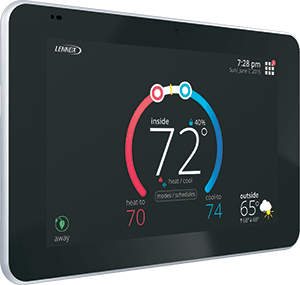
The pre-cool and coast schedule works well in practice, but it requires remembering to adjust the thermostat at the right times on the right days. A programmable or smart thermostat handles that automatically: you set the schedule once, and it runs the pre-cool in the late morning, holds a comfortable temperature through the afternoon, and eases back overnight without any manual input. During a week-long heat event, that automation adds up to real savings and a lot less second-guessing at 4 p.m.
If your current thermostat is a basic manual model, or doesn’t have the programming flexibility to build in a pre-cool window, an upgrade is one of the more straightforward improvements you can make before next summer’s heat arrives. Honeys Air, Inc. offers free, upfront estimates on thermostat installation, and our NATE-certified technicians can walk through the right options for your system and schedule. Give us a call at (209) 300-5238 to get started.